Address
304 North Cardinal
St. Dorchester Center, MA 02124
Work Hours
Monday to Friday: 7AM - 7PM
Weekend: 10AM - 5PM
Address
304 North Cardinal
St. Dorchester Center, MA 02124
Work Hours
Monday to Friday: 7AM - 7PM
Weekend: 10AM - 5PM

Custom Figure Factory
Custom Figure Factory
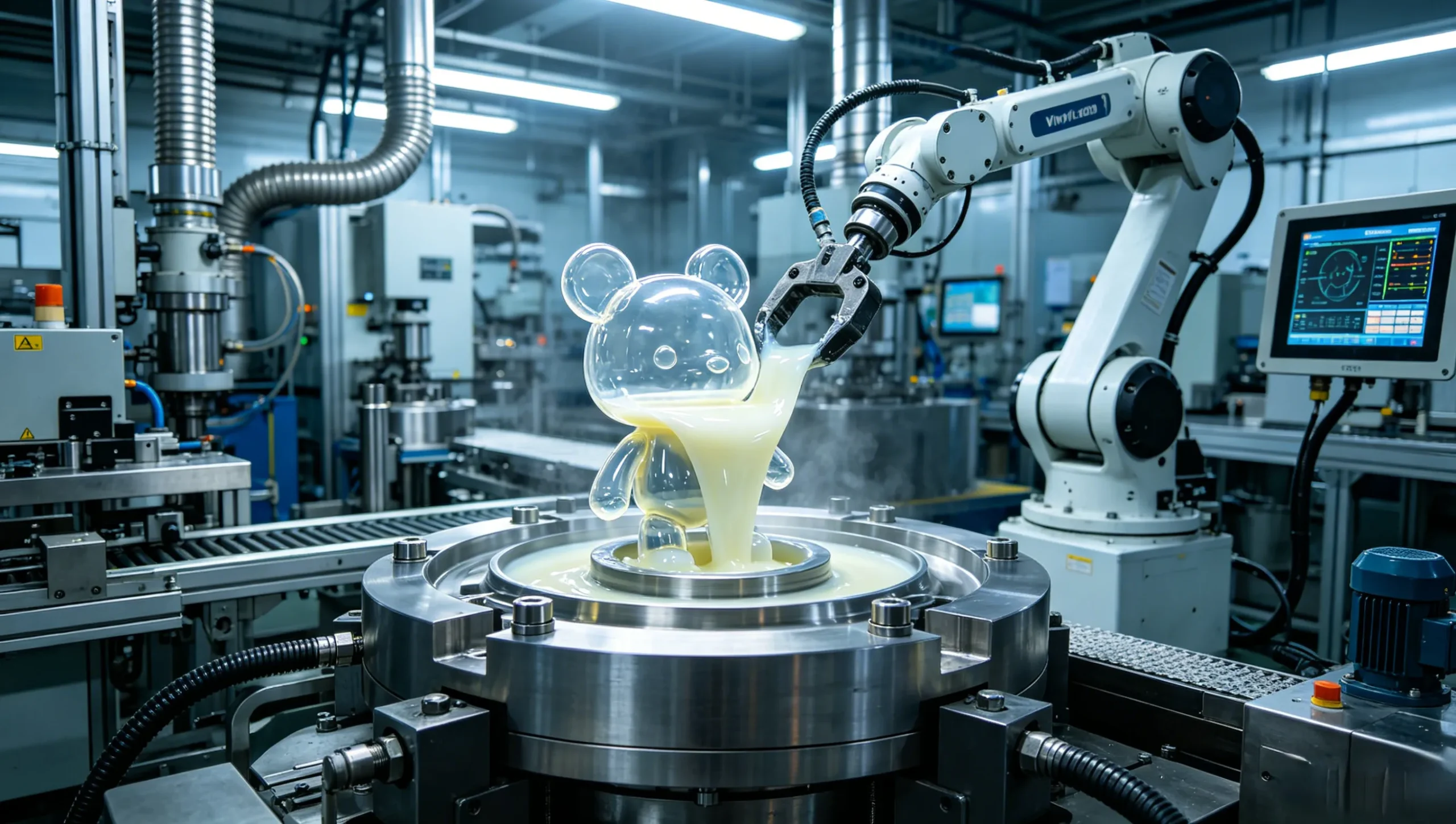
Roto-casting, commonly known as the vinyl molding process, traces its roots to Germany, where the world’s first roto-casting machine was developed in 1924. Using this equipment, manufacturers produced the very first vinyl toy — the iconic chocolate rabbit. From that point onward, roto-casting technology gradually became widespread and found applications across daily consumer goods, with vinyl toys emerging as an energetic, widely beloved product category.
A prevalent misconception is that vinyl denotes a specific raw material. To clarify: vinyl is in fact the common name for the roto-casting production technique. Formulations customized for this process incorporate special additives into base materials, giving finished roto-cast (vinyl) toys a distinct hand feel compared to standard solid PVC toys. This textural difference leads many people to wrongly categorize vinyl as an independent material type.
Full Workflow of Vinyl Roto-Casting
The complete roto-casting workflow consists of mold fabrication, high-temperature curing inside a roto-casting oven (operating at 250°C–280°C), cooling setting in a cooling oven (approximately 100°C), and post-production surface finishing.
Mold creation begins with electroplating copper layer by layer over an original prototype (other metal plating materials may be used for bespoke requirements, though those proprietary workflows remain undisclosed). This copper plating structure forms a hollow metal casting mold. Next, manufacturers prepare a compound blend using PVC paste resin (PVC pellets are occasionally used as an alternative), mixed with multiple plasticizers to tune the final product’s hardness and softness until the mixture reaches a creamy, latex-like consistency.
This liquid compound is poured into the finished metal mold. The filled mold is then heated while being continuously rotated to ensure uniform material distribution and consistent wall thickness across the interior. After heating is complete, the mold undergoes controlled cooling, and the finished hollow part is demolded afterward.
Roto-casting is primarily used to manufacture hollow plastic products. Its use of fine-grade PVC paste resin — much finer in particle size than conventional PVC resin — creates its characteristic unique tactile sensation. Economically, roto-casting molds are lower-cost and simpler to produce relative to conventional injection molding metal molds. However, the process has notable limitations: it operates without applied pressure, and liquid PVC paste has limited flowability. As a result, roto-casting struggles to replicate ultra-fine, intricate details on collectible figurines and detailed character sculptures.
